December 20

45 Lessons I Learned from Student Teaching

I have a confession to make: I am someone who tends to reflect on the negative situations that occur before appreciating the positive lessons I’ve gained. I find that from negative experiences come valuable learning opportunities, that is, once you have deciphered them from the muddy situation at hand. I found this to be something I did often during my first student teaching experience… Why did that lesson not go the way I had planned? Why did that student talk to me the way they did? Why didn’t everyone finish their project today? These were all questions I pondered once the school day was over, as I tried to find reasons and explanations during my own personal reflection. However, thinking back now, I mainly remember the amazing moments I had during my student teaching placement: the lessons I taught that went over well, the many laughs I shared with my students, and the incredible projects that  my students submitted.

Reflection is a huge part of personal improvement. I try every day to be better than the last, especially when it comes to my teaching. That is why for my last student teaching experience, I challenged myself to write 1 takeaway lesson at the end of each school day – good, bad, or otherwise! Although there were obviously many lessons I learned throughout each day, I stuck to my initial challenge of 1 per day. Thus, my list of 45 lessons I learned from student teaching was born.

45-lessons

1) First days can be hard for both students and teachers.

2) Structure, expectations, and routine are crucial components of classroom management.

3) Physical Education not only gets students moving, but it gets them engaged.

4) Fellow teachers have AMAZING ideas – utilize their knowledge and experience!

5) Number Talks do not only strengthen mental math and efficiency, but also numeric vocabulary.

6) A staggering amount of students in urban schools do not, or are unable to, participate in after school clubs or activities.

7) ADHD can cause a learning impairment for the student and their classmates if not supported properly.

8) Dr. Seuss is a genius and his stories can provide valuable lessons to both students and adults.

9) Students recognize the difference between “strict” and “fair”. Even when you might feel like you’re being strict, the students understand where you are coming from.

10) If you can make students care about the subject matter, they will be more engaged, produce higher-quality work, and learn more.

11) Genius Hour is a great form of inquiry-based learning and fosters deep learning through student engagement.

12) Know your students – find out what their interests are and use those topics to generate examples that engage students and ensure comprehension.

13) Offering a variety of approaches to the same subject matter provides an engaging and holistic educational experience.

14) Out of seemingly nowhere, your students will produce something that blows you away.

15) A lot can be said about the importance of teaching and demonstrating time management skills.

16) When all hell breaks loose, there will always be something that ends of making you smile.

17) Despite being friends with almost everyone in the class, students still get nervous during presentations, and that’s OK!

18) Field trips, like We Day, are great opportunities for students to learn outside of their classroom.

19) Revisiting a lesson that didn’t go over well the first time allows the teacher to correct their mistakes and the students to correct theirs.

20) Celebrate your victories and successes, no matter how big or small.

21) Some days, your students will blow you away when you least expect it.

22) Mentor teachers can build you up, make you feel confident, and prepare you to be a great teacher!

23) A built rapport with your students takes time, but pays off by saving time on classroom management.

24) Racism happens at all ages. Sexism happens at all ages. Bullying happens at all ages. Teachers must be ready to educate their students about these sensitive topics.

25) Coding is a fun and interactive way to teach Math and Science to students of any age.

26) You can still be a fun and easy-going teacher and expect respect from your students; one does not negate the other.

27) Each teacher has their own approach and philosophy of teaching; none are wrong, but it is about finding one that works for you.

28) Games in the classroom can get rowdy, but that just means that they are having fun while learning.

29) Many students struggle with transitions, so make sure you educate and prepare students with the skills necessary to make them as smooth as possible.

30) Teaching students to celebrate other students’ successes is difficult, but a necessary life skill to know.

31) Teachers must be very adaptable and be ready for anything to happen or change at any time.

32) Snow days are a whole new kind of crazy, but they make you reminisce on how AWESOME they were as a kid.

33) When you don’t feel your best, you cannot be your best. Self-care is so important.

34) Being evaluated only makes you better, even when you are a teacher.

35) Preparing an assembly for the entire school takes a lot of work, but the students (and teacher) feel so fulfilled when it’s over.

36) Don’t shy away from telling the class what you thought of their behaviour – good or bad – and holding them accountable.

37) Catholic liturgies and masses supplement the students’ education with faith, morals, and purpose.

38) There will be days that make you feel defeated; vent, find a silver lining, and laugh at what got you so down in the first place.

39) Physical Education should promote a healthy lifestyle, but through fun and play. Kin-Ball is the ultimate example of this!

40) What makes students want to learn? Kahoots!

41) Bus cancellations give you the opportunity to connect further with each student, allowing for more individualized attention and teaching.

42) The bond and respect gained through helping a student through a difficult situation is invaluable.

43) There are no bad kids, just kids to who sometimes make the mistake of doing bad things.

44) Don’t allow yourself to get caught up in the politics of teaching. Remember why you are there and what your passion and purpose is.

45) Kids are AWESOME! Teaching is a privilege and the best vocation in the world.

December 17

Year 2 Practicum Reflection: Week #8

Just like that, the final week of my evaluated practicum has come to an end! It has been a long journey getting to this point, full of long nights of planning and marking, and many visits to the online world of education. I guess this is what being a teacher is all about!

The week started off with a bus cancellation… Welcome to Ottawa! We joined two classes together and worked on some language throughout the morning. The first thing the students did was read an article and answer some comprehension and inference questions using the website readworks.org. This is a very neat tool in that it lets you assign a specific article and the teacher gets to view the responses and success rate for each student.

Later in the morning, we gave each student a chromebook and had them begin writing a story about the Christmas/winter season. In 5 minute intervals, the students would write and then pass off the chromebook to someone else. That person would continue the story and so on and so forth until we’ve had about 5 students write on the same story. We wrapped up the activity by reading some of the final products and it was fun to see how the story took a different turn with each new contributor.

This week in particular was full of culminating tasks. I had the students work on a descriptive writing task that had them creating and describing their own robot, something which I had modeled for them a week or two earlier. Their creativity was definitely flowing and their robots turned out really well. I made my way around the classroom and allowed the students to read me their descriptive writing to see whether or not I could draw their robot, which proved to be a great way to enforce editing and revision in their work. Here is the task description and the success criteria that I provided to the students:

descriptive-writing

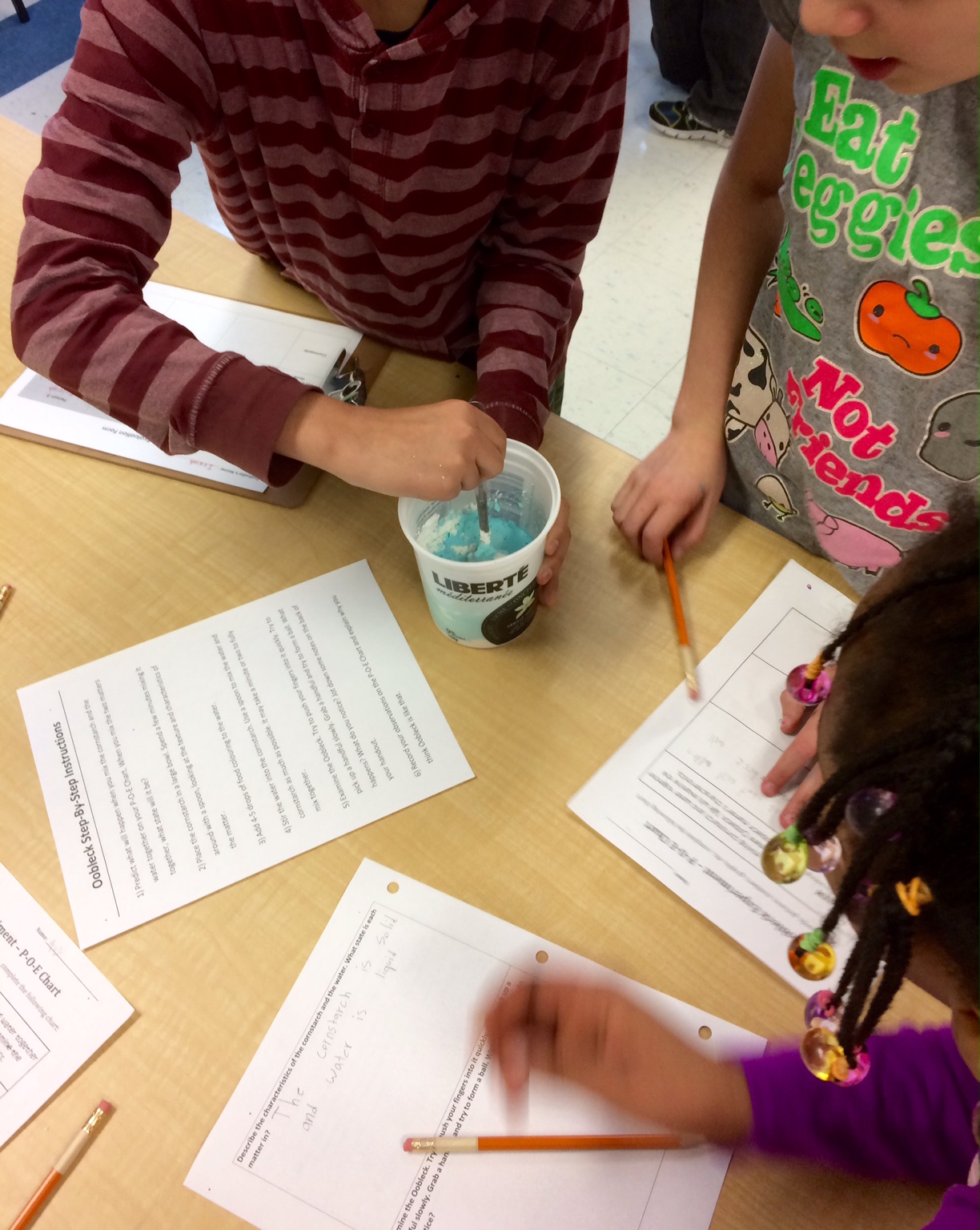
Another culminating task that we worked on in Science was a hands-on, inquiry-based experiment. We surprised the students by taking them out of the classroom and visiting the “secret science laboratory” in the school: the staff room! The students were so excited to enter into the staff’s territory and conduct their own messy experiment. I had step-by-step instructions, a P-O-E chart (predict, observe, explain), and materials set up in stations around the room and the students worked in groups of 3 to create Oobleck Slime. I found this task to be very intuitive for the students, since the slime is a solid when pressure is applied and a liquid when there is no pressure. THIS is what science is all about!

oobleck2oobleckoobleck1
This week was filled with advent-related activities! I facilitated an advent lesson where students in groups of 4 read one of many advent stories from the bible together as a group. They discussed its meaning and at what point during advent it took place. As a group, the students created a placemat with 4 sections: re-tell the passage, God’s meaning, a Catholic Graduate Expectation that is present, and a picture of the scene.

advent

advent2
Students also performed for their parents in a wonderful presentation of Once Upon a Starry Night. There were lights, costumes, actors, and a choir… It truly felt like we were at a theatre performance!

play
We also had a advent mass in our gymnasium, which was beautiful and set the mood for the advent season.

On the last day of my placement, I was given a wonderful gift from all of the students that I had taught throughout my placement: my morning grade 5s, my afternoon grade 5/6s, and my after school grade 4/5/6s! They gave me a copy of my all time favourite book “The Giving Tree”, which had lovely messages written inside from the students and my associate teachers.

I am very thankful for every experience that I had at Our Lady of Mount Carmel Catholic Elementary School. There were some tough days and many good days. There were some moments where I felt down-and-out, and some moments where I felt incredible, like I was making a difference in the lives of others. There were some days where I experienced some tough situations of bullying, and some days where I laughed with all of my students. This is growing up. This is education. This is teaching.

December 10

Year 2 Practicum Reflection: Week #7

To think that these next two weeks will be the last evaluated teaching experience I’ll have until I’m actually employed… I’ve come a long way as a teacher and have learned so much about education over the last year and a half. I’ve had my high points, where I have made a personal connection with a student or have seen a student exclaim, “ I GET THIS NOW!”. I’ve also had my fair share of lows, with periods of self-doubt, with phone calls home, and with personal prayer and reflection. Teaching is like a rollercoaster: the climb is nerve-wracking, the twists and turns will make you second guess your decision, but the thrill is something that you cannot find elsewhere.

At the After School Program, we had the Junior and Primary students team up again, but this time they were going to make festive decorations for the hallway. We gave them lots of paper, objects to trace, glue, and scissors, and they came up with some amazing creations. Now our hallway feels like a winter wonderland, complete with snowmen and reindeer.

We put a lot of emphasis on patterning this week so that we could wrap up that stand for now and move on to another concept. The students reviewed everything that we had learned in preparation for the assessment. On the morning of the test, we had a interactive activity that had students working in teams to identify a pattern rule and extend it as far as they could in a 2-minute period. After the 2 minutes were up, the timer rang and the students rotated to the next station and extended the previous team’s work. They had a blast collaborating and seeing how far they could extend each pattern.

Later that morning, while the students were out for recess, a little elf (Mr. Burton) went around to each desk and left a little something for each student to calm their nerves before the test.

This week in Phys. Ed., I was exposed to a new game by my Associate Teacher. She spoke about this massive ball that the kids could throw around and immediately I was in. The game is called Kin-Ball and there are a number of different variations of what you could do with this (trust me, it came with an activity manual). To get the students used to the ball, we had them lay on their backs and pass the ball to the next person around the perimeter of the gym. There were some kinks with students getting to excited and throwing or kicking the ball, but that was all part of the process of getting them used to accomplishing a task with the ball.

Next, we had the students work together in teams to move the ball from one side of the gym to the other without using their hands. There were some very interesting strategies, but nevertheless, the students had to work together to accomplish a goal which always makes for a beneficial Phys. Ed. and life lesson.

In Science, I wrapped our lessons on matter and its changes by demonstrating some chemical and physical changes. I started with the typical baking soda and vinegar experiment, but I put a balloon on the top of the bottle to show the students that a chemical change did occur, since a gas was created and inflated the balloon. Next, I did a demonstration of elephants toothpaste, which had the students very intrigued. I made sure that my ingredients were a little calmer than called for in the recipe so that I wouldn’t have to mop up the classroom, but then I showed them the video of what it could look like:


The next class, we discussed physical changes and how they differed from chemical changes. We talked about crumpling up paper and cutting it into pieces and how this depicts a physical change, since the paper is still paper. Next week, we will move into a culminating task where the students will conduct an experiment on their own. I can’t wait to see the student-directed, inquiry-based learning that takes place!

I still cannot believe that next week will be my last 5 days of practicum… I am thankful for these experiences and the practical learning I’ve been exposed to. Seeing other teachers thrive in their element is inspiring and I cannot wait to be in their shoes one day.

December 3

Year 2 Practicum Reflection: Week #6

This week was busy, busy, busy! Let me jump right in to my weekly reflection…

The Primary and Junior students in our After School Program teamed up to decorate for the winter season. The room that we run this program out of is used by a number of different programs and clubs, so we wanted to make sure that it was nice a festive, especially leading up to the Christmas holidays. All of the students did a wonderful job creating intricate snowflakes that we hung around the classroom to make it look like it was snowing inside. Such a simple project with such wonderful results!

A week or two ago, our staff had a professional development session about coding, courtesy of Dr. Flinn from the Ottawa Catholic School Board. This week, she spent her days instructing our students on how to use the various coding equipment that we have available to us. And let me tell you… THEY LOVED IT! I’ve never seen a library so energetic and vibrant in my life! Our students rotated through stations and as a team, they worked together to code Spheros, build robots, solve puzzles, and accomplish tasks. I am really looking forward to seeing how far their learning will go with the use of coding.

Our alcohol unit is coming along nicely. The students have learned the important vocabulary and have sorted through the various short-term and long-term effects of alcohol. This week, we explored to topic of peer pressure and how it related to alcohol. The students knew what peer pressure was, but have never really thought of how it could influence someone to make a bad decision and drink underage or irresponsibly. I gave each student a piece of paper that read, “Have a drink!” and then gave a different reason, such as, “Everyone else is doing it!” or “No one is going to find out!”. The students paired up, and for 2 minutes, tried to pressure their partner into drinking alcohol. The other partner had to listen to the arguments and respond to them so that they could get out of the situation. After two minutes, the roles reversed. The discussion afterwards was rich and a lot of deep learning took place.

For the first time this year, I got to watch my Grade 5/6 students read with their reading buddies in Grade 2. They were enthusiastic about the opportunity and I was impressed at the bond the pairings made. Every student engaged in some great literacy development, especially when the older students encouraged the younger students to read on their own. It was an all-around great experience.

For our descriptive writing unit, I created a slideshow presentation of my student’s writing from a task they completed last week. I kept the students’ work anonymous and typed it up so that they all looked uniform. We read each of the descriptions, which was of the same scenic picture, and discussed how each piece of writing could be improved. We correlated this information with our hamburger rubric that we used when discussing the difference between a Level 1, 2, 3, and 4. This exercise produced some valuable learning for the students, especially since it was personal for them (being their own work).

burger-rubric
I followed up the evaluative portion of my descriptive writing lesson with an interactive component. I had created a descriptive paragraph of a robot I found online. I read the description out loud to my students and, without showing them the image of the robot, had them draw it based on my writing. Afterwards, I revealed the image and we critiqued my descriptive writing based on how similar the robots looked. The students LOVED this activity – they got to draw AND critique the teacher’s work! Hopefully they keep their critiques in mind as they continue to work on their own descriptive writing.

my-robot
The highlight of my week was our Friday assembly. Our class had the task of creating and delivering an assembly to the entire school introducing our Catholic Graduate Expectation that we will be focusing on in December. The difficult part about this was that, unfortunately, my Associate Teacher was absent for a lot of the planning, due to an illness. That meant the supply teacher and I would accept the task with open arms and do the best that we could.

I don’t want to toot my own horn, but I was really happy with the way that the assembly turned out! Our students had scripture reading about lifelong learning, having trust in God, and fulfilling our potential. We also had students sharing their own goals and aspirations, showing that you are never too young or old to want to accomplish something. We taught the school about adopting a growth mindset and welcoming the power of “yet” into our lives. The big finale was a video that our students recorded and put together! They went around the school and asked students and staff about something they would like to learn one day and something that they have learned recently. This truly made the assembly feel like a school community, shining light on everyone’s goals and dreams.