February 26

Community Connections Project: Community Garden

Community-connected experiential learning opportunities are authentic learning experiences connected to a community outside the school at a local, national or global level. The connection can be a physical on-site experience, a virtual experience or a blended experience. It may involve connecting with people from various cultures in Canada or in other nations and countries. It might be learning from experts in a field of interest or connecting with politicians about a social justice issue.

A project idea I had to create connections between our school and the larger school community would be to create a community garden! Here is the outcome of my brainstorming session about this project idea:
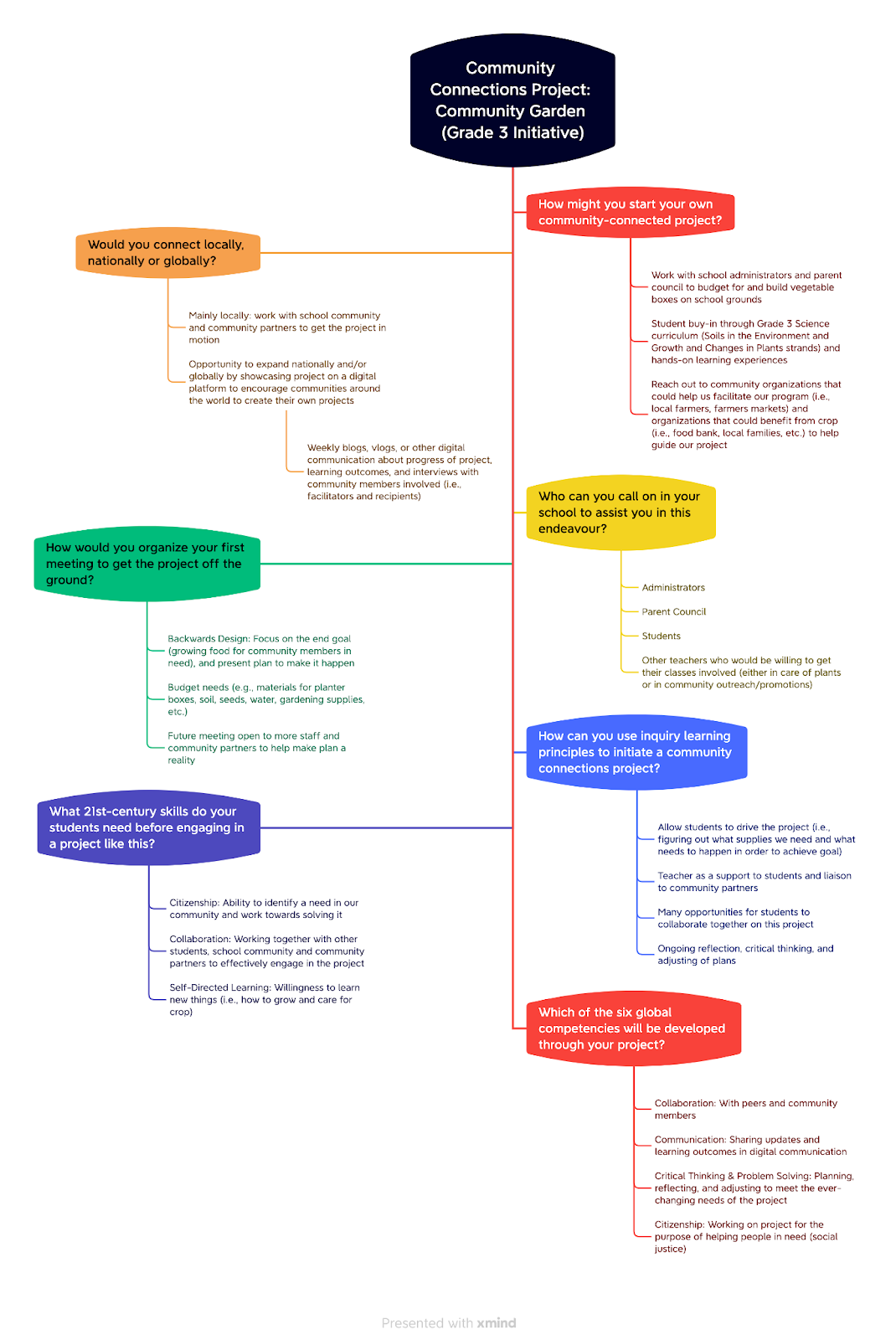
Following my brainstorm session, I created a more formal plan for pitching and implementing this project. The plan outline includes:

  • a description of the potential benefits of this project to the school and to the community
  • a description of how the project will help students develop the global competencies
  • a description of how the project will positively impact student achievement, engagement and well-being
  • an implementation plan
  • individuals and resources that could be called on in the community to support this project
  • a plan for assessing student learning
  • creative strategies to allow students to reflect on the experience and apply their learning

The plan for my Community Garden “Community Connections Project” is outlined in the following presentation:

Community Connections Project – Community Garden by Spencer Burton

This presentation could be use as a pitch to stakeholders to initiate this project at the school site.

What are your thoughts about this community connections project? What ideas do you have for a project that would work well with your school community?

February 22

Touch Screen Assistive Technology

Technology in the classroom can allow students to be self-directed learners in many ways. There are many types of assistive technology software that can help students. However, even with these softwares, common technology, such as Chromebooks, can sometimes have physical restraints that younger students or students with physical disabilities may struggle with. These restraints can hinder the students ability to use the technology effectively, therefore making it less self-directed. 

Touch screen technology, such as touch screen computers or iPads, has proved to be an effective assistive technology tool for these students. The touch screen can help them overcome the physical struggles of using certain technology and provide them with the ability to be self-directed learners. With touch screens, students can use their fingers to navigate through their devices, making it easier to use technology without the need for a keyboard or mouse. This can help remove physical barriers to learning and enable students with physical disabilities or underdeveloped motor skills to engage with technology in the classroom.

(Image Source: ATforED.com)

In addition to helping with the physicality of using technology, touch screens provide an interactive and engaging way for students to learn. With the ability to touch and manipulate the screen, students can interact with learning materials in a more hands-on way, which is especially beneficial for younger learners. Touch screen technology allows students to drag and drop items on the screen (i.e., digital manipulatives, sorting activities, etc.), zoom in on images, or even draw on the screen to illustrate their ideas, all with their fingertips. 

Arguably the best part of touch screen technology is that it is useful for all types of learners to use! Universal supports are a great way to meet the needs of all students, and touch screens offer just that. While all students may not rely on using touch to navigate technology, or they may prefer to use a trackpad or mouse, the option is still there to use whenever they would like, while also being available for those students who do rely on it. Therefore, I believe that, while often more expensive, schools should prioritize integrating computers and tablets that have touch screens into their arsenal of technology.

(Image Source: TeachHub.com)
February 16

FNMI Literature: Rabbit and Bear Paws

Diversity is such an enriching component to learning. Culturally Responsive Pedagogy describes “teaching that recognizes all students learn differently and that these differences may be connected to background, language, family structure and social or cultural identity” (Capacity Building Series: Culturally Responsive Pedagogy, pg. 2). It is crucial that we, as educators, value and use students’ diverse cultural backgrounds, through culturally responsive pedagogy, to enhance learning experiences and develop our students’ sense of belonging and citizenship in our global world.

A resource that I feel would work well with my Grade 3 students to integrate FNMI teachings and develop their citizenship competencies is the “Rabbit and Bear Paws” book series. This series of books are written by an author, Chad Solomon, who is a part of the Henvey Inlet First Nation community in Ontario (www.goodminds.com). Since he is a member of the FNMI community, we know his books’ content is authentic and appropriate to use as a teaching resource about FNMI culture and teachings. 

(Image Source: TeachingBooks.net)

Chad’s “Rabbit and Bear Paws” book series is a collection of early reader stories, each focusing on a different Grandfather Teaching. The Seven Grandfather Teachings are a set of traditional teachings from Anishinaabe culture that promote values such as respect, love, honesty, courage, wisdom, humility, and truth (www.aihschgo.org). These values are relatable teachings that students can easily recognize in their own lives and intentionally work towards developing further. This helps to bridge the gap between communities and recognize that our outlooks on life are similar, therefore developing our citizenship to our local, national and global communities.

Incorporating these teachings into a Grade 3 classroom in a respectful way can be done by using FNMI-curated resources that appropriately reflect their culture’s teachings. It is important that these teachings are used in a respectful manner, and given the content of the Seven Grandfather Teachings, they could be used as a tool for promoting positive behaviour in the classroom and school community. In fact, this year, our school, following the guidance of our board’s FNMI liaison, is using the Seven Grandfather Teachings as our monthly virtue assemblies. Each month, classrooms teach about one of the teachings and promote/identify this value in all that we do. Then, we come together at the end of the month as a school community to reflect and celebrate the strides we have made in developing that specific virtue. As we do, we always acknowledge the origins of the teachings and the importance of FNMI knowledge and culture; we must remember that, while these teachings are transferable across cultures, we must not claim them as our own.

(Image Source: IndigenousReflections.ca)

Books: https://rabbit-and-bear-paws.myshopify.com/collections/picture-books

Teaching Resources/Supports: https://rabbitandbearpaws.com/teachings/

February 14

Culturally Responsive Pedagogy and Global Competencies

Culturally Responsive Pedagogy describes “teaching that recognizes all students learn differently and that these differences may be connected to background, language, family structure and social or cultural identity” (Capacity Building Series: Culturally Responsive Pedagogy, pg. 2). Diversity is such an enriching component to learning. It is crucial that we, as educators, value and use students’ diverse cultural backgrounds, through culturally responsive pedagogy, to enhance learning experiences. 

(Image Source: New America – Teacher Competencies that Promote Culturally Responsive Teaching)

Global Competencies refer to a set of “knowledge, skills, attitudes, and values”  that help individuals understand and engage with the world around them (OECD: Global Competency for a Global World, pg. 7). These competencies include:

  • Critical thinking and problem solving
  • Innovation, creativity and entrepreneurship 
  • Self-directed learning 
  • Collaboration
  • Communication
  • Citizenship

Educators build upon these competencies in the classroom, through intentional learning activities, so that students are prepared to be effective and responsible citizens of a global society.

There are several connections between the use of Culturally Responsive Pedagogy and students’ development of Global Competencies. Firstly, in order to be a respectful and effective global citizen, students need to have an understanding of the world around them. By integrating Culturally Responsive Pedagogy into our teaching practice and having students learn about different cultures, ideologies, and perspectives, students will become a more knowledgeable and empathetic citizen of the world. 

However, we don’t just want our students to understand the world around them; we want them to be active members of a global community! Educators that are “engaged in the work of culturally responsive pedagogy are ‘committed to collective, not just merely individual empowerment’ such that the impact of this approach to teaching is directed towards making change for all members of society” (Capacity Building Series: Culturally Responsive Pedagogy, pg. 7). Culturally Responsive Pedagogy can help teach students that their voice and actions can make a difference, therefore developing social responsibility, global citizenship, and communication skills. These, too, are important global competencies that all students should develop within our classrooms.

We are only able to solve problems that we are made aware of. Therefore, by intentionally learning about both local and global issues, such as the Sustainable Development Goals, students can develop critical thinking and problem-solving skills that are essential for addressing global issues, especially when they become the adults in society that drive this change. We can also build upon these Global Competencies through a culturally responsive lens; by examining and discussing the ways in which different cultures approach and understand these issues (i.e., what led communities to experience this issue, what are the varying viewpoints from different groups involved), students can develop a deeper understanding of the complexities involved in solving global issues.

(Image Source: United Nations – Sustainable Development Goals)
February 10

Building a Professional Learning Network (PLN) Using Twitter

This workshop will be focused on Building a Professional Learning Network (PLN) Using Twitter. Using Twitter as a platform to learn, communicate, and collaborate with other educators has been valuable in my own professional development, and therefore, I believe it would be beneficial to share this with other educators. Currently, there are only a few other teachers at my school that use Twitter, which seems like a missed opportunity, given how beneficial it has been in my own growth as an educator. This workshop would be best facilitated in-person, as it allows the attendees to engage in hands-on activities, group discussions, and provides a forum for immediate answers to questions. 

Workshop Agenda:

  • Introduction (5 minutes)
  • Building a Professional Learning Network (15 minutes)
  • Understanding Twitter (25 minutes)
  • Break (5 minutes)
  • Hands-On Learning (40 minutes)
  • Break (5 minutes)
  • Connections (10 minutes)
  • Conclusion (5 minutes)
  • Post-Workshop Survey (10 minutes)

The Post-Workshop Survey could be sent virtually, or even as a Twitter DM to the attendees to provide them experience with this aspect of Twitter.

February 6

Pros and Cons of Professional Learning Networks (PLNs)

There is so much that educators can learn from other educators: new pedagogies, engaging lesson plans, classroom management strategies, just to name a few. While there is much to learn from the teacher in the classroom next door to ours, there is also a wealth of knowledge that we can gain from interacting with educators in other schools, in other cities, or around the world! Professional Learning Networks (PLNs) allow us to make connections with other educators that help to support and enhance our own learning and professional growth. The best part is that it can be as simple as reading someone’s blog or following someone on Twitter!

I began the process of creating my PLN using Twitter as the platform when I first applied for my Bachelor of Education. I started following various teachers in my area and over time it grew to educators around the world. Throughout my B. Ed. and eventually my career, I continued to post resources, reflections, assignments, and my thoughts on education. Selfishly, it was a great way to bank my own ideas so that I could refer back them to later, whether it was to use again for future class or to reference in an interview. Twitter was also a stress-free platform to use, as it is easy to log into Twitter and scroll for 5 mins or less a day and receive a wealth of information (ideas for teaching, a new theory to ponder, etc.).

Image Source: Twitter – @spencerburton

There are many positives to creating a Professional Learning Networks (PLNs). PLNs provide access to resources and ideas shared by a diverse group of educators. When I log onto Twitter, I can see various lesson ideas within a matter of seconds, without having to search for something specific. I’ve also been able to communicate and collaborate with various educators by replying to tweets or joining in on a Twitter chat. Participating in a PLN has also helped me to stay current in my teaching practice and philosophies. Interestingly enough, I also know that it has helped me to advance in my career. I once had a principal say to me at the beginning of an interview, “I follow you on Twitter, so I feel like I already know you and what type of teacher you are.”

Image Source: TeachThought via Sylvia Duckworth

There may be some downsides to participating in a PLNs. Participating in anything takes time, so while it may be easy to scroll through some tweets, some people may want to use their personal time for something other than education-related social media. PLNs can also create a space for you to negatively compare yourself to others. There are so many educators doing amazing things and posting them online, which may cause you to feel as though you are not good enough. It is important to remember that you should always be in a good head space before scrolling through any social media in order to view other’s work as inspiration, rather than comparison. As with any social media platform, Twitter can sometimes get negative… However, you create your own PLN and therefore have the ability to unfollow anyone that doesn’t meet your required level of positivity! 

Regardless of what platform you choose to create your Professional Learning Network on, remember your “why” for your PLN: to learn from and engage with others, not to compare yourself or engage in negativity.